




The Cartier Ceinture: An Overlooked Masterpiece of Design
When most people think of Cartier watches, the Tank or Santos probably comes to mind first. Both have become defining designs for the brand, but Cartier's history of watchmaking is filled with shapes that are considerably less familiar. Among them is the Ceinture, an unusual and elegant design that has been part of Cartier's story for nearly a century. First introduced in 1927 and revived in 1973 as part of the original Louis Cartier Collection, the Ceinture demonstrates just how much Cartier has historically relied on geometry and proportion to define its watches.

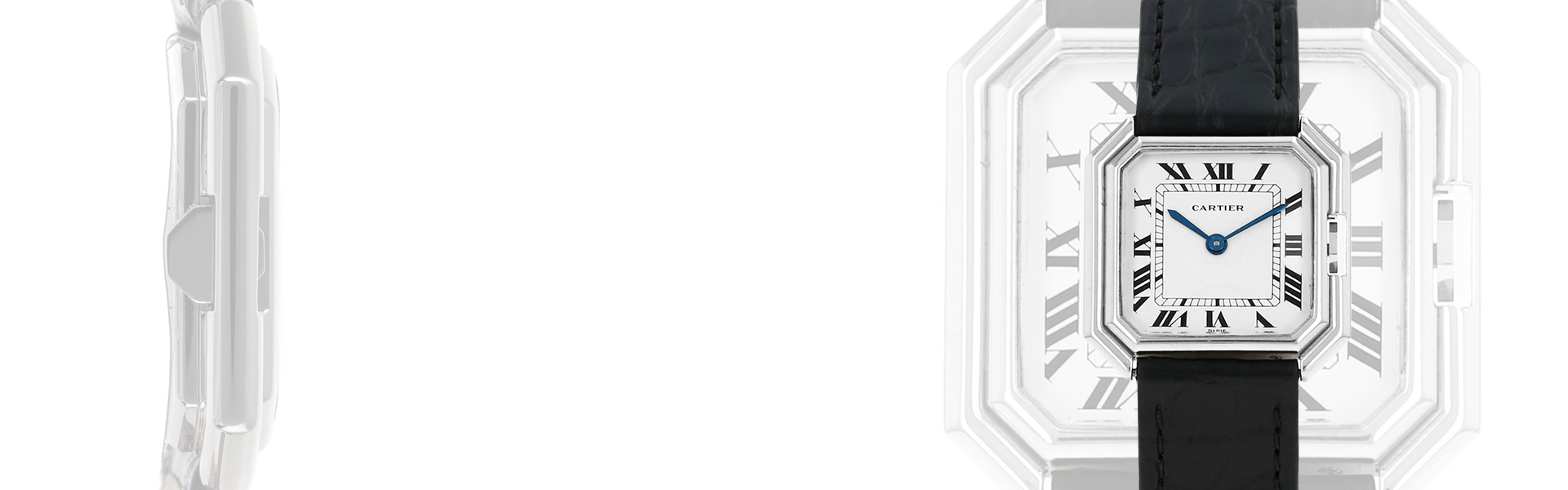
The name itself provides a clue to the design. Ceinture translates to "belt" in French, and the case takes inspiration from the shape of a belt buckle. Rather than a traditional square watch, the corners are cut to create an octagonal profile, surrounded by a stepped bezel that gives the case a strong sense of depth. It is a distinctly Cartier approach to watch design: recognizable through its proportions and geometry.

The case also contains one of the Ceinture's most interesting details: its crown. Instead of extending conventionally from the side of the case, the octagonal crown sits neatly within the architecture of the bezel at 3 o'clock. From above, this creates an unusually clean and symmetrical appearance, with the crown becoming part of the case's overall geometry rather than appearing as a separate component. It is a small engineering decision, but one that shows how seriously Cartier approached the relationship between form and function. That decision does come with a tradeoff. A crown designed to sit so closely within the case isn't as immediately accessible as the larger, more prominent crowns found on many traditional watches. Winding the watch can therefore require a little more effort and a different approach. It's a charming example of the compromises that can come with prioritizing design, and one that gives the Ceinture some personality.

The Ceinture became particularly significant again in the 1970s. In 1973, Cartier introduced the Louis Cartier Collection, a group of 12 watches that brought historic Cartier designs into serial production while also introducing several distinctive new shapes. The collection included familiar names such as the Tank Louis and Santos-Dumont alongside less common designs including the Ceinture, Coussin, Cristallor, Ellipse, and Vendôme. Rather than creating twelve variations on one basic case, Cartier used the collection to demonstrate the breadth of its design vocabulary. That makes the Ceinture an especially interesting watch for vintage collectors today. The Tank and Santos have become deeply established within modern watch culture, while the Ceinture remains considerably less familiar. Hodinkee has described it as one of the vintage Cartier models that continues to appear at auction but receives far less attention than the brand's most recognizable designs.

There is also something appealing about the Ceinture's relative obscurity. Collecting vintage watches often involves looking beyond the models that dominate every conversation, and Cartier's 1970s catalog offers plenty of opportunities to do exactly that. The original Louis Cartier Collection was defined by unusual case shapes, simple dials, and manual-winding movements, giving collectors a fascinating snapshot of Cartier during an important period of its watchmaking history. The Ceinture ultimately represents an aspect of Cartier that can be easy to overlook: the brand's willingness to let design lead. Its octagonal case, stepped bezel, integrated crown, and restrained dial don't depend on conventional sports-watch functionality or complicated mechanics to make an impression. The watch is interesting because of the way its individual elements work together.

For collectors willing to look beyond the Tank and Santos, the Ceinture offers a different way into Cartier's history. It carries nearly a century of design heritage while representing one of the more experimental periods in the brand's modern watchmaking story. And perhaps that's what makes it so compelling today. The Ceinture isn't trying to compete with Cartier's most famous watches. It offers something quieter: an unusual piece of the brand's history that rewards anyone willing to look a little deeper.