




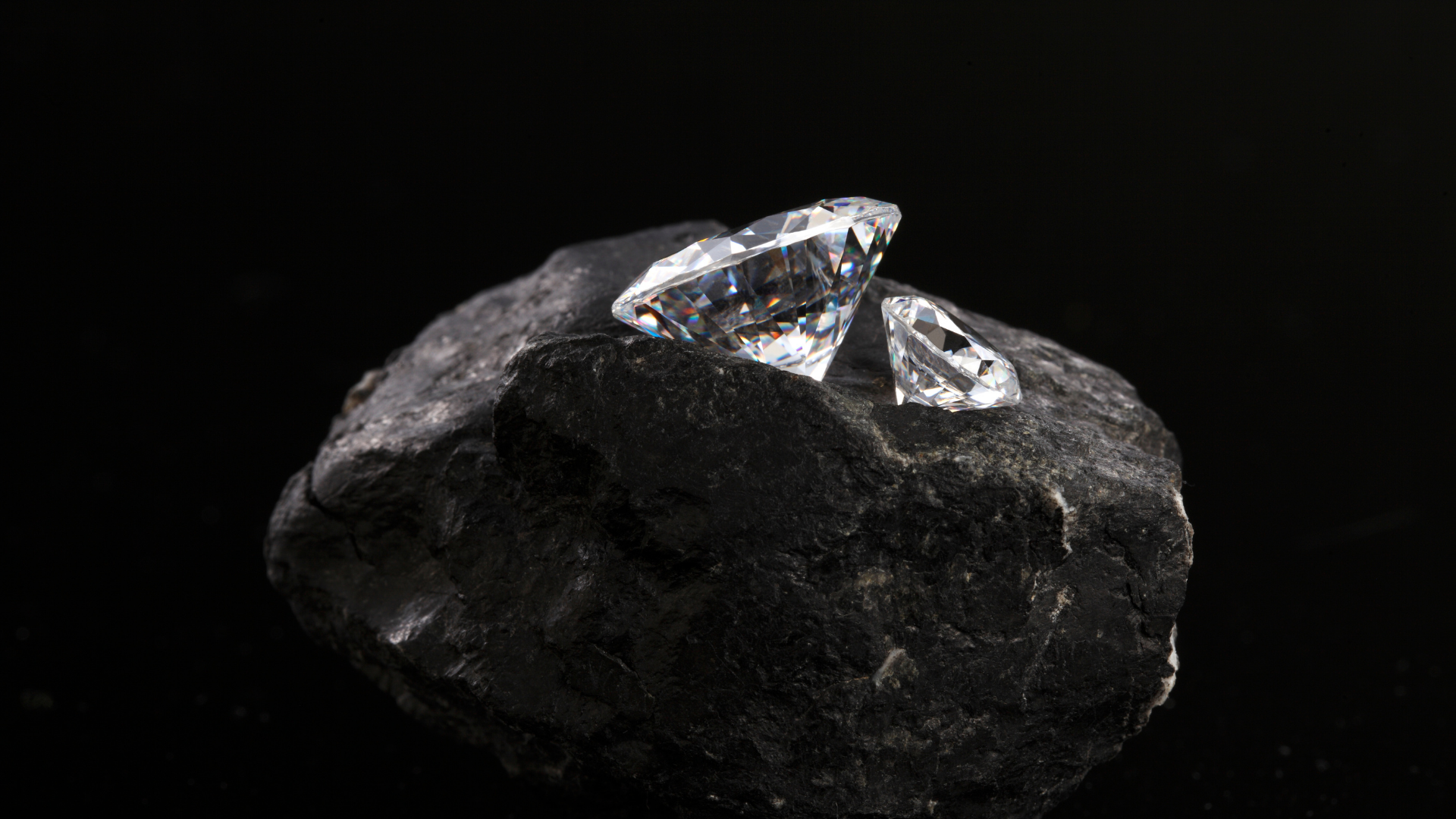
The Miracle of a Natural Diamond: Billions of Years in the Making
A natural diamond isn’t simply beautiful. It’s a piece of our planet’s history—formed deep within the Earth millions or even billions of years ago.
There are beautiful objects. There are rare objects. And then there are natural diamonds—tiny pieces of our planet that began their journey millions or billions of years before human beings existed.
Most of us know that natural diamonds come from deep within the Earth. But when you understand how deep, how old and how unlikely their journey really is, a diamond becomes even more extraordinary.
Your Diamond Could Be Billions of Years Old
Natural diamonds didn’t form hundreds of thousands—or even just millions—of years ago.
Scientists have determined that natural diamonds formed approximately 90 million to 3.5 billion years ago.
Consider that for a moment.
Earth itself is about 4.56 billion years old. Some diamonds were therefore forming when our planet was still relatively young.
And dinosaurs? They came much, much later. Even the youngest natural diamonds formed before the dinosaurs disappeared approximately 66 million years ago. Many natural diamonds were already billions of years old before the first dinosaur ever walked the Earth.
When you wear a natural diamond, you may literally be wearing something that has existed for most of Earth’s history.

Before it ever became a polished gemstone, a natural diamond spent millions or billions of years beneath the Earth. Diamonds are brought toward the surface in ancient volcanic rocks such as kimberlite.
Born More Than 100 Miles Beneath Our Feet
The age of natural diamonds is only part of their remarkable story.
Most formed approximately 125 miles beneath the Earth’s surface, under tremendous heat and pressure within the Earth’s mantle.
Some diamonds originated at astonishing depths approaching 435 miles underground.
For perspective, the deepest hole humans have ever drilled—the Kola Superdeep Borehole—reached only about 7.6 miles below the surface.
We have never come remotely close to physically reaching the places where many natural diamonds were created.
So how did they get here?
An Incredible Journey to the Surface
Natural diamonds didn’t simply sit underground waiting for someone to dig them up.
Millions of years ago, extraordinarily powerful volcanic eruptions carried diamonds upward through the Earth in diamond-bearing rock such as kimberlite.
Imagine something that formed more than 100 miles beneath your feet being propelled toward the surface by an ancient volcanic event—and surviving the journey intact.
The volcanic eruptions that transported diamonds to accessible parts of the Earth’s crust happened millions of years ago. One of the most recent known diamond-bearing kimberlite eruptions occurred more than 20 million years ago.
The diamond in a piece of jewelry today may therefore have spent billions of years beneath the Earth, survived an extraordinary volcanic journey toward the surface, remained hidden for millions more years—and eventually been discovered by us.
How Rare Is a Natural Diamond? Picture a Mining Truck.
The scale of diamond mining helps put their rarity into perspective.
Imagine a mining haul truck carrying 50 tons of earth and rock.
And don’t picture the ordinary dump truck you see hauling dirt away from a construction site.
Mining haul trucks operate on an entirely different scale. Even a 50-ton mining truck is enormous compared with the road-going dump trucks we see around town. The truly gigantic haul trucks used at some of the world’s largest mines can carry hundreds of tons in a single load. Their tires alone can be taller than a person, and an ordinary construction dump truck can look almost like a toy when parked beside one.
Now imagine all that material being moved and processed in search of something that might eventually sit on the tip of your finger.
According to diamond researcher Dr. Ulrika D’Haenens-Johansson of the Gemological Institute of America (GIA), commercial diamond mines may average roughly 0.3 to 1 carat of diamond per ton of material extracted, although yields vary considerably from mine to mine.
And finding diamonds doesn’t mean finding jewelry-quality diamonds.
Many recovered diamonds are tiny. Others aren’t gem quality. Only a fraction ultimately possess the combination of size and quality that makes them exceptional gemstones.
Dr. D’Haenens-Johansson offered an extraordinary example: To produce a 1-carat D-color, Flawless natural diamond, a mine may, on average, need to extract and process approximately 100 tons of ore.
Think about that the next time you look at a beautiful one-carat diamond.


The scale of modern mining can be difficult to comprehend. Some of the world’s largest mining haul trucks can transport hundreds of tons of material at once. Yet enormous quantities of earth and rock may ultimately yield only a tiny amount of gem-quality natural diamond.
A Tiny Time Capsule From an Earth We Could Never Visit
Perhaps the most fascinating part of a natural diamond is something jewelers usually call an inclusion.
People often think of inclusions simply as imperfections.
Scientifically, however, some inclusions are priceless.
As a diamond forms deep inside the Earth, it can capture microscopic crystals and other materials from its surroundings. The diamond then seals and protects those materials during its journey to the surface.
These inclusions can contain minerals such as garnet, olivine, diopside and kyanite. Scientists study them to understand conditions deep inside our planet—places human beings cannot physically reach.
In other words, some diamonds are essentially time capsules from the ancient Earth.
Those tiny inclusions can help scientists determine where a diamond formed, provide clues to its age and reveal information about portions of our planet hundreds of miles beneath us.
What we might casually call an “imperfection” can actually be a microscopic piece of Earth’s history.
A treasure within a treasure.
The Hidden Art Inside a Diamond
There is another remarkable side to these inclusions: they can be breathtakingly beautiful.
For decades, renowned GIA gemologist and photomicrographer John I. Koivula has photographed the microscopic worlds hidden inside gemstones. Viewed under magnification and carefully illuminated, features invisible to the naked eye can suddenly resemble landscapes, clouds, feathers, abstract paintings and even recognizable objects.
Koivula’s work helped pioneer the field of gemological photomicrography—the art and science of photographing what exists inside gemstones.
The result is a fascinating intersection of geology, science and natural art.
And unlike an artist’s painting, these patterns weren’t created by a human hand.
They were created by nature, deep inside the Earth.

An extraordinary microscopic world hidden inside a natural diamond. This dramatic hydrogen-cloud inclusion resembles a Venetian mask—an example of the unexpected natural art that can exist inside a diamond. Photomicrograph by John I. Koivula/GIA.
More Than a Beautiful Stone
This is what makes a natural diamond so fascinating.
We often talk about diamonds in terms of carat weight, cut, color and clarity. Those characteristics are important. But they don’t tell the whole story.
A natural diamond is something the Earth created under extraordinary conditions, at extraordinary depths, over a timescale that is almost impossible for the human mind to comprehend.
It may be billions of years old.
It formed more than 100 miles beneath your feet.
It survived an ancient volcanic journey to the Earth’s surface.
It remained hidden for millions—or billions—of years.
And after enormous quantities of earth were searched and processed, it was discovered, cut and polished before eventually becoming something that could be worn and passed from one generation to another.
Human beings can cut a natural diamond.
We can polish it.
We can grade it.
We can set it into a beautiful piece of jewelry.
But we cannot recreate its history.
And perhaps that’s the real miracle of a natural diamond.
When you give someone a natural diamond to mark an engagement, anniversary, birth or another important moment, you’re giving them something whose own story began millions or billions of years before ours—and that may remain long after we’re gone.
What else can you own or wear that is millions or likely billions of years old?!
That’s more than rare. That’s extraordinary.
Inspired by diamond research presented by Dr. Ulrika D’Haenens-Johansson, senior manager of diamond research at the Gemological Institute of America, as reported by JCK, along with educational resources from GIA.